
Oakland University summit examines free speech, civil discourse and political violence on college campuses
Community & impact
 October 13, 2026
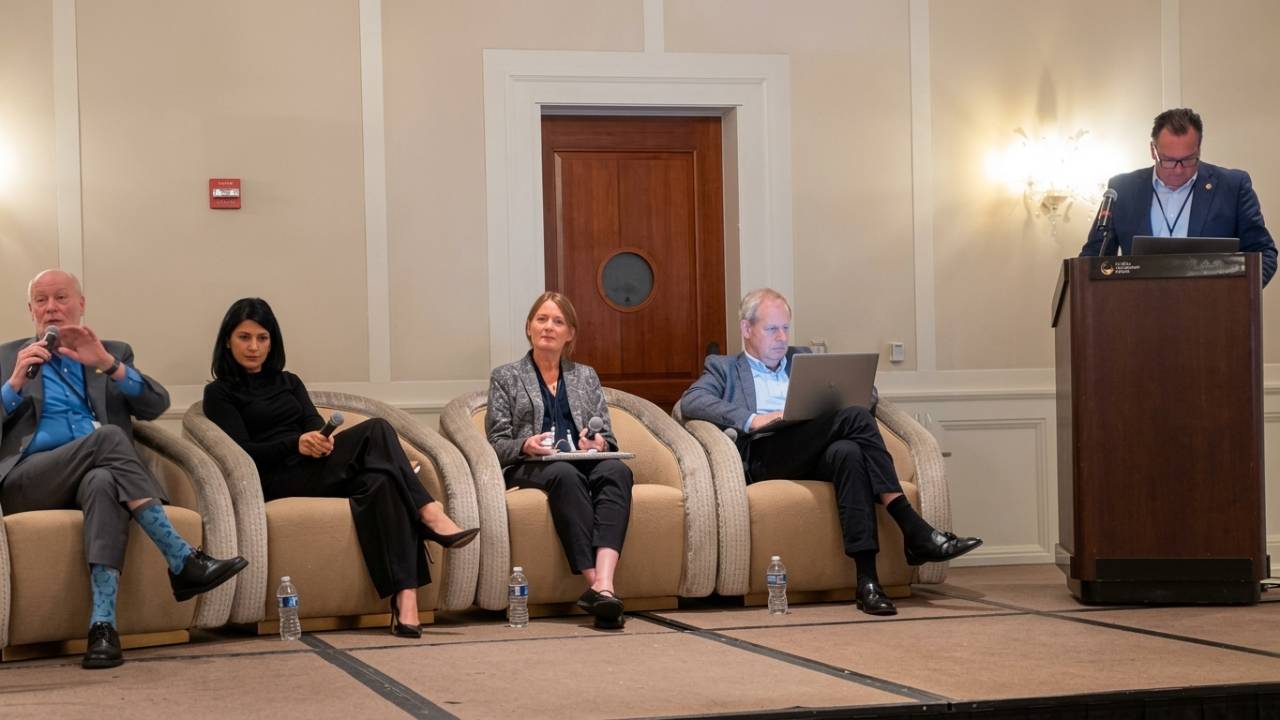
Oakland University brought together national experts, higher education leaders, researchers and civic organizations Sept. 30 and Oct. 1 for a Summit on Civil Discourse, Freedom of Speech and Political Violence on College Campuses.
Hosted by OU’s Center for Civic Engagement and generously supported by the William Davidson Foundation, the two-day summit examined challenges facing colleges and universities, including free expression, academic freedom, political polarization, campus protests and political violence. Discussions also explored how universities can create environments where students and faculty engage thoughtfully with viewpoints different from their own.
Dave Dulio, professor of political science at Oakland University, helped organize the summit and served as a moderator during the event.
“The Summit was intended to bring leaders from colleges and universities across Michigan together to discuss these critical issues,” Dulio said. “I'm delighted to report that we had over 20 campuses in Michigan send representatives to participate. The Summit provided a space not only for attendees to hear from experts who have diverse perspectives but also to hear from those who are actively working on these issues on campuses around the state and nation.”
The summit reflects OU’s ongoing efforts to promote civil discourse and prepare students to participate in a democratic society. The university has expanded opportunities for students to engage with differing perspectives, including a student free speech competition and programs focused on civility and constructive debate.
The summit opened Sept. 30 at Meadow Brook Hall with a private reception, followed by the 2026 Dennis Muchmore Public Policy Series featuring Greg Lukianoff and Nadine Strossen, authors of The War on Words: 10 Arguments Against Free Speech — And Why They Fail, at Varner Recital Hall.
On Oct. 1, participants gathered at the Royal Park Hotel for a series of panels and discussions focused on free expression, political violence and civil discourse.
The summit comes as debates over speech and political expression have become increasingly prominent on college campuses and across the country. Research has found that some students believe certain speakers should not be permitted on campus, while others report concerns about expressing their own views. Panelists examined these tensions and the challenges they create for higher education.
Protecting free expression while supporting academic freedom
The morning session on Oct. 1 began with “The First Amendment and Free Expression on College Campuses,” featuring Howard Gillman, chancellor of the University of California, Irvine; Mary Anne Franks, Eugene L. and Barbara A. Bernard Professor in Intellectual Property, Technology, and Civil Rights Law at George Washington University Law School; Sarah Ludington, clinical professor of law and director of the First Amendment Clinic at Duke University Law School; and Eugene Volokh, Thomas M. Siebel Senior Fellow at the Hoover Institution at Stanford University.
Panelists discussed the distinctions among First Amendment protections, free speech and academic freedom, as well as the responsibilities of colleges and universities when controversial issues or speakers come to campus.
They addressed challenges ranging from security costs and student safety to harassment and doxxing. Panelists also emphasized that academic freedom does not mean every idea is appropriate in every academic setting and that faculty have professional responsibilities to teach within their areas of expertise.
Rather than shielding students from objectionable ideas, panelists said universities can help students encounter, understand and critically evaluate competing viewpoints. Gillman noted that academics do not have to be politically neutral to be successful scholars or teachers as long as they fulfill their professional responsibilities.
Ludington discussed the First Amendment audit framework and the importance of intentionally creating programs that model productive disagreement.
Understanding political violence
The second panel, “Campus Political Violence in Modern America,” featured Kenneth Andrews, Tileston Professor of Arts and Sciences at Washington University; Ellyn Maese, senior research consultant at Gallup; and Sean Westwood, director of the Polarization Research Lab at Dartmouth College.
Panelists emphasized the importance of distinguishing political disagreement, offensive or hurtful speech, protest activity and physical violence.
Westwood discussed research examining Americans’ attitudes toward political violence, while Maese highlighted Gallup research showing that fewer Americans feel comfortable expressing themselves and that social media use is strongly associated with attitudes toward political violence.
Andrews provided historical context, noting that perceptions of protests as violent can be cyclical and that most people involved in political advocacy are not violent. Protests and civic organizations, he said, can also help connect people and strengthen democratic life.
For Oakland, the discussion reinforced the importance of giving students opportunities to engage with difficult issues in ways that encourage critical thinking rather than polarization.
Putting civil discourse into practice
The afternoon session began with a civil discourse roundtable featuring journalists, former Michigan legislators and public policy leaders. Panelists discussed how civility can be applied in an increasingly polarized political environment.
Civility, they said, is more than simply being polite. It involves the ability to disagree effectively without dehumanizing others. They emphasized assuming good intentions, listening to understand rather than simply preparing a response, avoiding competition and investing in relationships over time.
The discussion also examined social media’s role in amplifying outrage and ideological divisions. Panelists stressed that ideological agreement is not required for productive engagement and that disagreement can be a starting point for developing policy solutions when people maintain mutual respect.
The roundtable also reflected Oakland’s broader efforts to equip students with practical tools for navigating disagreement, including coursework centered on the civility work of journalists Nolan Finley and Stephen Henderson.
The roundtable was followed by a presentation from Simon Cullen, who discussed Sway, an artificial intelligence-facilitated discussion platform designed to promote open inquiry and civil discourse in higher education.
Cullen described how the platform pairs students with classmates who hold opposing views and facilitates structured text conversations around controversial topics. The model grew out of a Carnegie Mellon University course that explored topics including abortion, gun rights, immigration, affirmative action and the existence of God.
Students reported gaining a better understanding of opposing viewpoints and improving their ability to communicate with people who disagree with them. Cullen demonstrated Sway for summit participants using questions about university protest encampments and whether speakers accused of promoting discrimination should be permitted to speak on campus.
University leaders discuss free speech and institutional responsibility
The summit concluded with a presidents’ panel featuring Oakland University President Ora Hirsch Pescovitz, Adrian College President Jeff Docking, University of Michigan President Domenico Grasso and Michigan State University President Kevin Guskiewicz.
The presidents discussed the complexities of free speech, institutional neutrality and restraint, academic freedom, harassment and the role of university leaders in responding to controversial issues.
Pescovitz discussed Oakland’s approach to campus expression, including the university’s efforts to provide space for protests and counterprotests while using appropriate time, place and manner restrictions. She also described Oakland’s efforts to promote civility through student programming and education.
Oakland does not have a formal institutional neutrality policy, Pescovitz said, but its approach is generally closer to institutional restraint, with the president speaking when she believes it is important for the university or its community.
“I believe that the president’s voice is precious, which means that I restrain myself from speaking out,” Pescovitz said. “Except when I feel it’s very important for me as the leader of the institution to speak out.”
The panel also explored the responsibilities of university presidents when speaking in their official capacities and the importance of providing students with opportunities to encounter differing viewpoints.
“Students deserve to hear both sides of the equation, then they get to decide,” Docking said.
For Oakland, the summit provided an opportunity to bring together diverse perspectives around issues that directly affect higher education and to advance the university’s role in fostering thoughtful dialogue.
To learn more about Oakland University’s Center for Civic Engagement and its work to promote civic learning, dialogue and engagement, visit oakland.edu/cce.