History Comes Alive Series
Special Thanks to Founding Sponsors John and Annette Carter
Join us for History Comes Alive, an informative and entertaining series offered by OU’s Department of History and endowed by John and Annette Carter. All History Comes Alive lectures will be held at 7 p.m. in the Oakland Center at Oakland University. We encourage you to RSVP to reserve a spot below. All lectures are available in person or virtually through Zoom (Meeting ID: 973 8079 4214 and Passcode: 561063).
The 2025-2026 John and Annette Carter History Comes Alive Lecture Series is also made possible in part by a grant from Michigan Humanities, an affiliate of the National Endowment for the Humanities.
RSVP: History Comes Alive Series - 9-15
RSVP: History Comes Alive Series - 10-6
RSVP: History Comes Alive Series 11-4
RSVP: History Comes Alive Series - 1-12-27
RSVP: History Comes Alives Series - 2-16-27
RSVP: History Comes Alive Series - 3-10-27
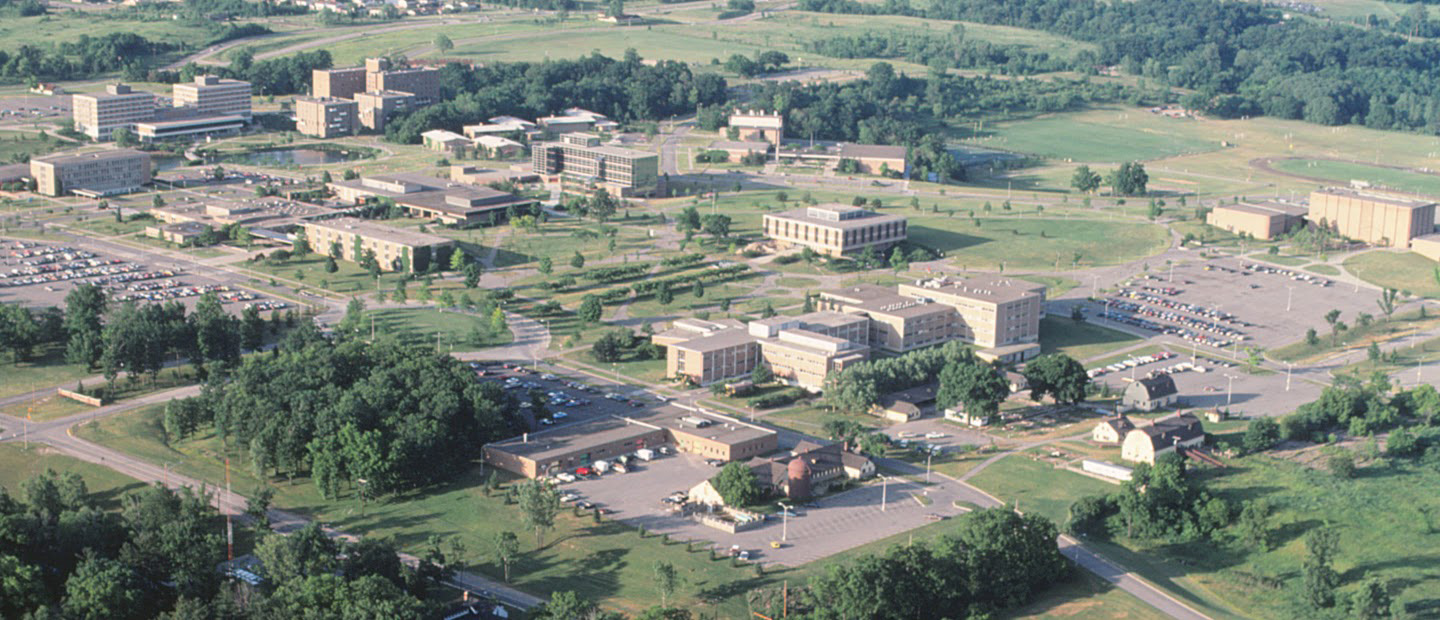
Oakland University opened its doors to 570 students in 1959 with 2 buildings, North and South Foundation Halls, and 24 pioneering faculty members.
The campus weaved into the Meadow Brook Estate, home to OU’s founder Matilda Dodge Wilson. Wilson, widow of automotive pioneer John Dodge, had lived at Meadow Brook with her second husband, Alfred Wilson, since the late 1920s. Her gift of 1400 acres and $2 million in 1957 laid the foundation for Michigan State University Oakland, which later became the independent OU of today.
The very first courses were offered in Fall 1958 including, home economics, history, sociology, English and basic college subjects, held in a building of the Meadow poultry farm. Wilson even enrolled in the speed reading class. The first convocation took place on September 14, 1959 in the Oakland Center, which was the third building constructed on campus.
Today, nearly 20,000 students continue to find educational opportunities at OU, preparing them for a rapidly changing workplace and society. Rooted in OU’s foundational pioneer spirit, there are more than 2,000 world-class scholars and researchers that offer students and the community experiential, thought-provoking guidance.
More information about OU’s history is available through Kresge Library’s Early History.
History Comes Alive welcomes students, faculty and the surrounding community to take part in any of the free lectures offered.
Speaker: Lorri Glover, Saint Louis University
Date: 7 p.m. Tuesday, September 15
Location: Banquet Room B, Oakland Center
When the delegates to the Second Continental Congress pledged their lives, fortunes, and sacred honor in support of independence from Great Britain, those words, which might seem overblown today, were a measured and true assessment of their situation. The men who signed the Declaration knew that proclaiming their vision for newly independent and united states was a public act of treason. How did elite, learned, middle-aged men in velvet knee-britches get so radical? How could colonists’ complaints over imperial tax policies spiral into a revolutionary reimagining of government and society? And where did the ideas, language, and audacity come from? This History Comes Alive talk explores the messy, dangerous, often misunderstood origins of the Declaration of Independence and frames that document in the wider context of eighteenth-century radical independence-seeking.
Speaker: Alan Taylor, University of Virginia
Date: 7 p.m. Tuesday, Oct. 6
Location: Oakland Center Gold Rooms
Located in southern Virginia, along the Sussex County line with Southampton County, the plantation of Tower Hill verged on the region embroiled in Nat Turner’s Rebellion, the bloodiest revolt by enslaved people in the United States. The owners of Tower Hill left behind a massive trove of private papers, previously untapped by historians, and those papers illuminate the deeper origins and broader range of Turner’s revolt.
Speaker: Nicola Phillips, Royal Holloway, University of London
Date: 7 p.m. Wednesday, Nov. 4
Location: Oakland Center Ballroom A
Approximately half of those who attended the First Continental Congress in 1774 were lawyers, as were at least 25 of those who signed the Declaration of Independence. Yet, since 1750, many American lawyers had been sent to train in London’s Inns of Court and to learn their trade by listening to arguments in Britain’s highest and most ancient court, that of the King’s Bench at Westminster Hall. It was considered vital to learn not just legal principles, but also the most effective form of rhetoric to publicly defend the rights of the people. The impact of legal and political rhetoric was widely respected in Britain and America, but so too was the physical performance and the ability to deploy powerful emotive arguments to persuade judges, juries and audiences. Thomas Erskine became the leading lawyer in King’s Bench during the later eighteenth century. He was also an opposition MP and a Whig patriot lawyer like many in America. His emotive rhetoric won him significant trials for treason, freedom of the press and the right to trial by jury. Like Alexander Hamilton, Erskine’s brilliance could also move a court to tears. Copies of Erskine’s speeches were hugely popular amongst the Founding Fathers and bound copies can be found in the libraries of Thomas Jefferson, George Washington (who replied personally) and John Adams, who instructed his sons to read them. This lecture will highlight the transatlantic links between lawyers’ rhetorical skills and their political beliefs. It also asks how and why emotion and physical expression proved so effective in American and British courtrooms during this period.
Speaker: Karen Miller, Oakland University
Date: 7 p.m. Tuesday, Jan. 12
Location: Banquet Room B, Oakland Center
The requirements of defense planning during World War II forced a physical reconfiguration of Detroit. The needs of manufacturing took precedence and dictated an urban design that would have long-standing consequences for Detroiters in the 1950s and 1960s..
Speaker: Derek Hastings, Oakland University
Date: 7 p.m. Tuesday, Feb. 16
Location: Banquet Room B, Oakland Center
Ernst Röhm was, after Hitler, the most prominent of all Nazi leaders until he was executed on Hitler’s orders in 1934. Following his death, the Nazi regime attempted to destroy all traces of Röhm’s existence, including virtually all of his personal effects, photos, diaries, correspondence and private writings. As a result, Röhm remains the least-studied and perhaps least-understood of all major Nazi figures. This lecture will trace the major contours of Röhm’s life and career, in addition to discussing the challenges of writing Röhm’s biography in the face of the extensive destruction of source material.
Speaker: Mark Nicovich, William Carey University
Date: 7 p.m. Wednesday, March 10
Location: Banquet Room B, Oakland Center
Historians have long noted that infectious disease, in its many forms, is the great enemy of civilization, striking not only at the human body, but also at all aspects of society. We are keenly aware of this in our own age, as we continue to deal with the long hangover of the COVID-19 pandemic, and as epidemiologists warn of future epidemics and pandemics that are certain to arise at some point. This means that the history of disease and its impact on past human societies is absolutely critical, yet there are many difficulties in researching past disease events, especially before the development of modern germ theory and diagnostic testing. How can we identify and verify disease events in the accounts of ancient writers, when they possess little or no scientific knowledge or terminology with which to understand or describe the pathogens they faced? In this talk, we will discuss how current scholars are using an array of new methodologies, including modern genomic science and geographic information systems, in concert with traditional textual and archeological evidence to identify contagions and to better understand how these infections spread in antiquity.
History Comes Alive welcomes students, faculty and the surrounding community to take part in any of the free lectures offered, involving the American Constitution and Revolution, Meadow Brook Farms, Medieval healing and Japanese empires.
Speaker: Thomas Madden, Saint Louis University
Date: 7 p.m. Tuesday, September 16
Location: Banquet Room b, Oakland Center
In 1786 the American Ambassador to England, John Adams, wrote a "handbook for lawgivers," which examined most of history's fallen republics and the seeds of their destruction. This work, the Defence of the Constitutions, was in the hands of the framers of the U.S. Constitution when they met the following year in Independence Hall. This lecture, drawn from the author's new book, “The Fall of Republics: A History” (forthcoming from Princeton University Press, Spring 2026), will explore the factors that led to the collapse of some of history's most important republics, and the lessons that the American framers drew from those cautionary tales.
Speaker: George Milne, Oakland University
Date: 7 p.m. Tuesday, October 14
Location: Banquet Room B, Oakland Center
“Matilda’s World" investigates the land that eventually became the campus of our university. This world began to take form in 1908, when Matilda Dodge and her husband John, who founded the automobile companies that bear his name, purchased a 308-acre farm in Oakland County, Michigan. The couple was seeking refuge from the bustling industrial city of Detroit. Over the following few years, they expanded their holdings. John’s death in 1920 did not stop Matilda from developing the estate even further to eventually encompass more than 1,400 acres. On that land, she created a world of charm and grace with the help of her second husband, Alfred Wilson, a lumber magnate, when they constructed Meadow Brook Hall, a 110-room neo-Tudor mansion, developed Meadow Brook Farms into a sprawling agricultural experiment and created housing for her extensive staff, including workers’ homes as well as servants’ quarters in her mansion.
Speaker: Alex Noonan, SNA International
Date: 7 p.m. Wednesday, November 12
Location: Banquet Room B, Oakland Center
During the administrations of Thomas Jefferson and James Madison, New England conservatives became convinced that French emperor Napoleon Bonaparte controlled the federal government. This lecture will explore how this conspiracy theory took hold in New England and nearly broke apart the early American republic.
Speaker: James Naus, Oakland University
Date: 7 p.m. Tuesday, January 13
Location: Banquet Room B, Oakland Center
Medieval texts are filled with stories of miraculous healing—so many, in fact, that it becomes difficult not to believe something real was happening. These healing miracles were not merely tales of divine intervention, but deeply embodied experiences shaped by faith, ritual, and cultural expectation. Drawing on new research in neuroscience and the history of medicine, along with fresh interpretations of well-known (and not so well-known) medieval sources, this lecture explores the beliefs and science behind what made healing "work" in medieval Europe and offers a new framework for understanding how belief, authority and the body came together to make the impossible not only plausible, but real.
Speaker: Erin Brightwell, University of Michigan
Date: 7 p.m. Tuesday, February 17
Location: Banquet Room B, Oakland Center
Even today, the question of “resistance versus collaboration” continues to haunt appraisals of Japanese-language writing by Taiwanese authors during the period of Japan’s colonial occupation of Taiwan. Rather than focusing on questions of identity or authorial political allegiance, however, this lecture examines Japanese-language short stories by Taiwanese authors between 1937-1945 to try to understand how the experience of colonialism was refracted through literature. Examining selected works of Wang Changxiong 王昶雄 (1916-2000) and Long Yingzong 龍瑛宗(1911-1999), the lecture asks what motivates their respective fictional characters: how they understand the world(s) and options around them. Within the context of empire, these options are per force limited, but the rationalizing rhetoric characters employ or the compromises they make to survive—if survival is what they aspire to—tell us something about empire and control itself.
Speaker: Todd Estes, Oakland University
Date: 7 p.m. Wednesday, March 11
Location: Banquet Room A, Oakland Center
The year 2026 represents the Semiquincentennial of the American Revolution, an event which is nearly as controversial today as it was in 1776. We will explore the Revolution’s promises and how much it achieved and Americans' understanding of the meaning and significance over time. Additionally, this lecture will analyze the interpretations and the memories of the Revolution seen in school textbooks, at historical sites, in popular culture, in our politics and in the public imagination — and why these views spark such strong feelings. With these themes and other questions, this lecture will provide historical context during this 250th anniversary year.
The History Comes Alive series has intrigued and enchanted Oakland University’s students, faculty and surrounding community since 2003. Please explore some past topics for a look into the lively and thought-provoking discussion it inspires: -2024
Department of History
371 Varner Dr.
Rochester, MI 48309-4482
(location map)
(248) 370-3510
fax: (248) 370-3528